
The play and its date
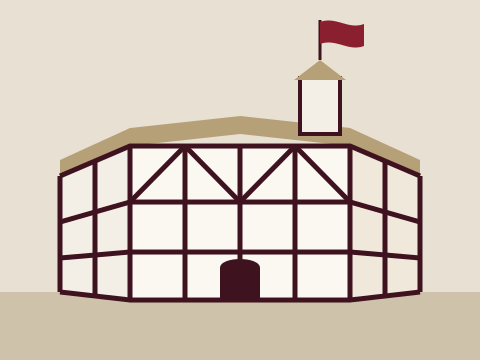
Shakespeare’s Julius Caesar is the reason the murder is remembered as three Latin words. The editors of the Folger Shakespeare Library, Barbara Mowat and Paul Werstine, write that Shakespeare may have written it to be the first of his plays staged at his company’s new Globe theatre in 1599. The Folger notes that it was first published in the First Folio of 1623, and that this text is the source of every later edition.
For his story Shakespeare went to Plutarch. In her essay for the Folger, Coppélia Kahn of Brown University names Shakespeare’s main sources as Plutarch’s biographies of Caesar, Brutus and Mark Antony. Reading those Lives beside the play shows how much of the plot, and how many small details, came straight from Plutarch, and how carefully Shakespeare chose where to depart from him.
The scene around the line
The murder comes in Act 3, Scene 1. Metellus Cimber pleads for the recall of his banished brother, Publius Cimber, and the other conspirators join in, Brutus among them. Caesar refuses in a speech about his own firmness:
But I am constant as the northern star,
The petition gives way to violence in four quick lines. In the Folger text Cinna and Decius kneel; Caesar brushes them off and asks Doth not Brutus bootless kneel?
, that is, if even Brutus kneels in vain, why should they do better? Casca cries Speak, hands, for me!
and strikes. In the Folger text the line comes as the others rise and stab; in the Project Gutenberg stage direction, Brutus is the last to strike. Caesar’s response is a single line, the one numbered 85 in the Folger edition:
Et tu, Brute?
Then fall, Caesar!
Dramatically, the two halves do different work. The Latin question is aimed at one person and asks only whether he, too, is among the attackers. The English half is Caesar giving up: once Brutus has struck, he stops resisting. That is very close to the version Plutarch reports from some writers, in which Caesar fights off the others but, on seeing Brutus’ drawn dagger, covers his head and sinks. Shakespeare kept the moment of surrender and gave it words.
What Shakespeare took from Plutarch
Many of the play’s best-remembered details are in Plutarch’s Life of Caesar or Life of Brutus first:
- The soothsayer. Plutarch’s seer warns of the Ides and later replies that they have come but not gone; Shakespeare’s says
Beware the Ides of March.
and, on the day,Ay, Caesar; but not gone.
- Calphurnia’s dream. Plutarch’s Calpurnia dreams of holding her murdered husband and begs him to stay home; in the play, near the start of Act 2, Scene 2, Caesar says
Thrice hath Calphurnia in her sleep cried out,
- Decius. Plutarch’s Decimus Brutus Albinus talks Caesar out of staying at home; Shakespeare’s Decius Brutus does the same.
- Artemidorus. Plutarch’s Greek teacher presses a warning on Caesar that he never reads; Shakespeare’s calls out
Hail, Caesar! Read this schedule.
- Lean Cassius. Plutarch reports Caesar saying he was
not much in fear of these fat, long-haired fellows, but rather of those pale, thin ones
; Shakespeare’s Caesar saysYond Cassius has a lean and hungry look;
- Casca first, and Pompey’s statue. In Plutarch, Casca strikes first, and Caesar dies at the foot of Pompey’s statue; both details are in the play.
- The apparition. Plutarch’s phantom tells Brutus
I am thy evil genius, Brutus, and thou shalt see me at Philippi.
Shakespeare’s, which the stage direction calls the Ghost of Caesar, saysThy evil spirit, Brutus.
andTo tell thee thou shalt see me at Philippi.
- Strato. Plutarch reports that some said Brutus’ friend Strato held the sword on which he died; in the play Strato says
I held the sword, and he did run on it.
What he changed
Set against this, Shakespeare’s changes stand out. The largest is the one this site is about. Plutarch gives Caesar no words for Brutus; Suetonius and Dio report a question in Greek only as something others said. Shakespeare gives Caesar a question for Brutus in Latin, and makes it his last words. Caesar’s cry at Casca, which is the only speech Plutarch gives him during the attack, is gone.
He also moved the gesture. In all three ancient accounts Caesar covers his face as he dies. On stage he speaks instead, and the covered face reappears in Mark Antony’s funeral speech in Act 3, Scene 2, together with a line that names the betrayal outright: This was the most unkindest cut of all;
. The double comparative, “most unkindest”, is printed in the Project Gutenberg text as it stands.
Kahn points to a quieter change. She observes that Shakespeare’s Rome is more intensely a man’s world than Plutarch’s, and that Portia and Calphurnia each speak in only two scenes, while Plutarch tells many stories in which women figure prominently. The Portia of Dio’s history, who wounds her own thigh to prove she can keep a secret, survives in the play, where she speaks of Giving myself a voluntary wound
, but in a smaller space.
And the setting changed. The Project Gutenberg text heads the murder scene “Before the Capitol”; the ancient writers put it in the hall Pompey had built beside his theatre. Antony’s speech keeps Pompey’s statue, so the play remembers the old setting even while moving it.
From Antony’s verdict to “the noblest Roman”
The play’s last word on Brutus also comes from Plutarch. In the Life of Brutus, Plutarch reports that Antony said, in the hearing of many people, that Brutus was the only one of the conspirators moved by what seemed to him the nobility of the deed, while the rest acted from envy and hatred of Caesar. Shakespeare gives Antony the same judgment over Brutus’ body:
This was the noblest Roman of them all.
All the conspirators save only he,
Did that they did in envy of great Caesar;
The match is close: Shakespeare’s Antony says almost exactly what Plutarch’s Antony is reported to have said. It also shows something about the play’s balance: the man who speaks “Et tu, Brute?” into the audience’s memory is the same man the play ends by calling the noblest Roman.
The other lines that stayed
“Et tu, Brute?” is one of several lines from this play that are often quoted on their own. A few of them, as printed in the Project Gutenberg text:
- Cassius to Brutus, Act 1, Scene 2:
The fault, dear Brutus, is not in our stars,
But in ourselves, that we are underlings.
- Brutus to the crowd, Act 3, Scene 2:
Not that I loved Caesar less, but that I loved Rome more.
- Antony to the crowd, Act 3, Scene 2:
Friends, Romans, countrymen, lend me your ears;
and the refrainFor Brutus is an honourable man,
The refrain is the clearest example of how the play handles betrayal. Antony repeats that Brutus is honourable until the word turns into its opposite, without ever saying so. The reading on betrayal follows that idea further.
A play that keeps the argument open
Mowat and Werstine set the play against a long argument about the murder. They note that Dante put Brutus and Cassius in hell as traitors, while Shakespeare’s contemporary Sir Philip Sidney saw Caesar as a rebel threatening Rome and Brutus as the wisest of senators. Their verdict is that Shakespeare’s dramatization has kept this debate alive
.
The line at the centre of this site sits right on that fault. Spoken by a dying man to his friend, it makes Brutus a traitor. Read against the rest of the play, and against Plutarch, it is one side of a question the play never closes. That may be why the three words outlived nearly everything else in the scene.
Next: Betrayal as a theme: from Dante’s frozen lake to Antony’s “unkindest cut”